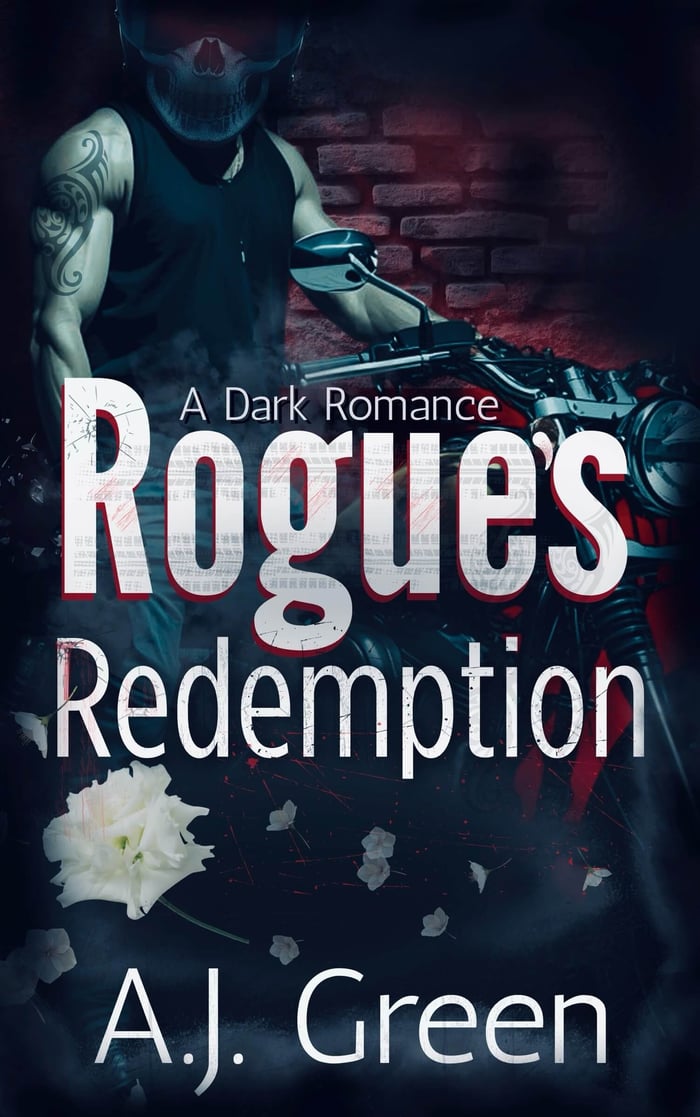
Rogue's Redemption
A.J. Green
Trigger Warning
This is a dark romance featuring explicit sexual scenes. Possible triggers include stalking, abuse, torture, blood, violence, guns, knives, gun play, mental health issues, and addiction.
Emmy was used to running…
Chased by the shadows of her past, she’d gotten good at hiding. She was prepared for darkness creeping in. She was prepared for the chase that always followed.
But she was not prepared for him.
Rogue was a different kind of man, one she didn’t see coming. The kind who made her want to give in and find freedom in the trust of surrender. But that was extremely dangerous, and they both knew it.
He wanted to save her from her past.
Never did he imagine that she could save him in return.
CHAPTER ONE
The Plain Girl
Emmy
Winter crept in, and with it, that familiar weight of coldness that made everything feel even more useless. I felt it in my bones; in the way my fingers stiffened after polishing too long. The cold always came with dead weight — not just in the air, but behind my ribs. A quiet, dragging tiredness clung to me. It was the kind of cold that used to drive people together, into kitchens and pubs and living rooms strung with fairy lights. Now it only seemed to underline how alone I was inside it.
My lips hovered inches above the bronze plaque, breath fogging against the cold metal. The warmth from my body disappeared into it instantly — just like everything else I touched, gone in seconds. I exhaled onto the metal, watched, almost mesmerized, as my fingerprints faded away. I traced each letter with a yellow cloth, moving slowly, deliberately, the way people traced names on gravestones. My nails dug into the fabric as I wiped around the edges, gently, carefully.
There was something undeniably intimate about working with antiques, though most people wouldn’t agree. They’d probably say I was one of those women who had aged herself too soon — always dressed in browns, lurking behind circular glasses, hiding in libraries. A sigh escaped my lips, my breath turning into white mist and vanishing into the still air of the empty room. No music. No murmured voices. No distant clatter of cups or laughter bleeding in from somewhere else. If only they knew how hard I’d worked to become that woman.
Two years.
Two winters.
Two full Christmases since I left.
I remembered gripping the steering wheel so tightly I bruised the heels of my hands. I didn’t look back. If I had, I wouldn’t have left. Since then, December had stopped feeling like a season and started feeling like a test. Every shop window, every strand of twinkling lights, felt less like an invitation and more like a warning — proof that other people still belonged to something I’d been quietly exiled from.
The year before, I had been holed up in a cottage in Devon with nothing in sight. No shops. No cameras. No way for my ex to find me. Just darkness outside the windows and the sea somewhere beyond it, restless and unseen. Even then, I kept the lights off. The soft blinking of them — once comforting — now made my chest tighten, my pulse stumble, as if joy itself had learned how to ambush me. Maybe this was the Christmas I’d finally be able to put up a tree. A small one, to fill the void in the corner by the front door. Not for guests — there were none — but as proof that I still understood the ritual. That I hadn’t forgotten how people marked time together. That way, if I didn’t make it long enough to end up in a museum myself, there would still be something there that belonged to me—a quiet rebellion after everything that had happened last time.
Even if I vanished tomorrow, I wanted something left behind that was mine.
And yet somehow, he still turned up at my front door by Christmas Eve. He knocked like it was nothing. Said he missed me. Smiled like we were picking up where we left off. He even brought a bottle of wine — a Christmas red, my favorite. The same one I had drunk the night I left.
People always asked, “Why didn’t she leave?” They never asked what it felt like to run when someone knew the shape of your routines better than you did. Marcus knew everything. What I wore to bed. What coffee I ordered. The precise time I took my makeup off. I had a perfectly memorized map.
I’d lived in six different towns in just over two years. None of them further than four hours from the coast. Maybe it was stupid, always running to water — but he hated the sea. Said it made him feel “small.” I liked that.
The Christmas before it all went wrong, I had spent two whole years with Marcus — the man I thought I was going to marry. He was everything you could possibly want in a man. He had his head screwed on right, and I was an absolute mess. He had money, a motorcycle, and a ridiculous amount of ambition. He was fiercely protective and caring in all the right ways.
At first.
He never let me walk on the roadside, never let me ride a bicycle without a helmet. He opened doors, ordered my food for me because he “knew what I liked,” and paid for everything without making a show of it. I never cooked my own dinner the entire time I was with him.
He loved watching horror movies with me and taking long walks in the dark — said it was romantic, said he liked how brave I was.
We were deep in the woods on the 22nd December, the path barely visible and icy underfoot, when he suddenly let go of my hand and stepped off the trail. I laughed at first, thinking he was joking as he ran off into the trees, then my laughter was stolen by the darkness as I realized I couldn’t hear him anymore. I called his name once. Then again. The dark pressed in from all sides, heavy and absolute, damp with the smell of earth and leaves, my heart skidding wildly in my chest as the forest closed ranks around me. You hear horror stories all the time about what happened to the girl in the woods. It’s in the news every day. And I was next, so why didn’t I move? I stood exactly where he left me, because every instinct told me that if I chose wrong — if I ran, if I called out again — he would know. My heart slammed against my ribs as I waited for permission to exist while risking my life.
When he came back, he was smiling. He said he just wanted to see what I’d do. Said I’d passed. Wrapped his arms around me like he was soothing a child, told me I was safe now. My heart was still hammering, my legs weak, but I nodded anyway. I didn’t want to ruin the moment. I didn’t want to be dramatic. He kissed my forehead and called me “sensitive,” like it was a pet name. That was when the thought flickered — small and easily extinguished — that something wasn’t right. But he cared. He always knew what was best for me. And by then, I had been trained not to say no. It was always in my best interest. Always because he loved me. I suppose that should have been a red flag, but by that point, I may as well have been color-blind.
We met at university while I was doing my psychology degree. People only ever took psychology for one of two reasons. One, they wanted to help others. Two, they wanted to help themselves. While I wished I had been doing it for the first reason, truly, I just wanted to know what was wrong with my brain. Me? I wanted to know why I constantly craved these morally grey men and somehow still had the audacity to be shocked when they turned out to be bad people.
Marcus had changed suddenly, like a light switch had been flipped. Protective became obsessive. Loving became critical. Every day felt like walking through a gauntlet — my clothes were never right, my laughter too loud, my texts too slow, my eyes too wandering. And if anyone else looked at me across a room, that became another reason for him to pounce.
But he never raised his voice where anyone else could hear it. He waited until doors were closed, until we were alone in the car or the kitchen, and then he would unload — a low, controlled fury that went on far too long. He listed my faults calmly, methodically, like evidence of all the reasons he had to leave me, but then promised he never would. Sometimes he would punch the wall beside my head, just hard enough to leave a dent. Other times, he would grab a glass and smash it into the sink, then watch me flinch as if that was the point. Each time getting closer and closer to my body. Hinting that it was a matter of time until he hit me, and even then, it would be my fault. I would have pushed him, driven him to it.
In public, he preferred quieter punishments: a cutting comment slipped into conversation, a hand gripping my thigh too tightly under the table, a look that told me I’d pay for it later. At university, it was a comment delivered lightly, almost fondly — “You’d be so pretty if you wore more color,” said like advice, not criticism. Or he’d text me photos of his friends on campus while I was in the library, girls laughing in the sun with drinks in their hands, and say what a shame it was that I was always so busy. If I bristled, he smiled and told me he was only encouraging me to “come out of my shell.” By the time we got home, I was already apologizing — not for what I’d done, but for failing to be someone else convincingly enough.
It wasn’t just annoying or insulting — it was corrosive. I felt my thoughts shrink to fit his approval. My chest would tighten at the sound of his voice, my reflection in the mirror a stranger I was afraid to know. My confidence crumbled in quiet increments, like sand slipping through my fingers, until I began to question the most basic parts of myself. The curiosity I had brought to psychology — so I could understand my mind — turned inward in desperation, as if studying myself would somehow stop him.
Every moment I remained, another piece of me would vanish, leaving a hollow imitation of who I was. I had to leave, or there would be nothing left at all.
I had to leave.
I found myself scrolling through forums under the guise of ‘research’ and took a trip to see my Mum. The one person I knew I could get away with seeing. She told me to run — as far away as I deemed necessary. She told me to take the car and phone her when I was safe. So, I did as I was told. Story of my life — just doing as I was told instead of making my own decisions because it felt easier, safer, and in the end, it was my downfall.
I kept running. He kept catching up.
He wasn’t just controlling anymore. The world he inhabited was one where I existed only for him to dominate, humiliate, and terrify.
Once, he left a gift on my doorstep — a soft, purring cat he called an apology. A way to make amends. I watched it curl into my lap, warm and trusting, and for a heartbeat I almost believed him.
Then I looked up.
He was standing in the doorway, eyes wild, his hand raised just enough for me to see the knife tucked beneath his coat, catching the low light. A promise, not yet delivered. I froze, my chest locking tight as the cat hissed and clawed at my arm, frantic, as if it understood before I did that I had to run.
He stepped closer, backing me into the corner, grinning — that same smile that always made my stomach drop straight through the floor.
“You think you can leave me?” he said, teeth clenched, his voice stripped of anything human.
Headlights suddenly washed across the wall — a car slowing outside, gravel crunching beneath its tires. Somewhere nearby, a door slammed. A voice carried, indistinct but close enough to matter. Marcus hesitated, just for a second. His gaze flicked toward the window, the knife dipping a fraction, his jaw tightening — not with doubt, but calculation.
That second was enough.
I lunged past him as he swore, my shoulder clipping the doorframe as I stumbled outside, the kitten shrieking in my arms, claws raking my skin as my heart tried to tear its way out of my chest. He didn’t follow — not with witnesses so close. I ran for the car, lungs burning, every step driven by a single, brutal instinct: survive.
That was the first time he’d sabotaged my car. I only got to the next village over before something had crackled out of existence. The engine wouldn’t turn over, and I had no idea why. Everywhere I went, I was terrified, waiting for him to pop up and slash my tires or kill my cat – or me. I imagined him lurking — by the bus stop, behind the trees, watching from across the street.
His obsession had become a shadow that stretched impossibly far.
A predator that didn’t need to speak to terrify me. I was already haunting myself with the memories of him. My pulse thickened in my throat, my hands trembled, and my mind constantly calculated exits, hiding spots, and escape routes. Sleep became a luxury I could not afford; every creak, every passing stranger, could be him. I realized then that it wasn’t just a relationship I was fleeing. It was a danger so real, so deeply rooted in his obsession, that nothing — no apartment, no friends, no routine — could stop him. I wasn’t just afraid. I was running for my life.
Logic dictated that the smaller the town, the fewer bad people I could bump into. Naturally, my next move after that was to a different, gorgeous coastal town. Something about the sea calmed me, especially when there was a full moon. Life on the edge of a small coastal town had its perks. It was quiet — just the way I liked it. I spent my days lost in the mazes of beautiful butterfly specimens, shelves of classic literature, and sculptures of Roman Emperors whose disapproving stares followed me as I sneaked in a few pages of smut on my breaks. It was a blessing to have stone eyes watch over me all day. Made a nice change from being followed.
November was a strange comfort. Firstly, because the fact that I had made it this long without uninvited guests arriving was a miracle, and secondly, because I got to wear my big coat. I loved my big coat. It was fur-lined, green on the outside, and kept me warm after several nights sleeping in my car. Grabbing my coat from the rack, I layered it over my white button-up shirt. The sea was too harsh to bear, but that only made the coastline feel more my own, untouchable. No crowds, no one to recognize me or my carefully curated look, a strange mix of clichés I had carefully amassed from Pinterest. It was the little things, the small pleasures, that kept me going. That’s why I had painstakingly put together my winter wardrobe set: oak-brown Ugg boots, black leggings, and a deep green knee-length coat, chosen solely for the depth of its pockets. And tucked away in a grey box on the floor of my wardrobe, the matching knitted black bobble hat and gloves.
It would be nice to have someone tell me I looked good for once, a reason to justify this outfit, and for being late to work.
Despite knowing I had an impressive talent for choosing the wrong men, I never stopped craving the protection Marcus gave me in the beginning. I told myself it was nostalgia, not weakness. Still, I was terrified of the danger that came with trying again — of misreading another smile, another gentle hand placed too deliberately at my back. I was stronger now.
I knew that a weaker person would’ve given up long before now. I knew how to spot red flags before they unfurled into something lethal. I trusted my instincts in a way I never had before. I could take care of myself — financially, emotionally, physically. I had learned how to survive. But there was a part of me that was so tired of surviving. Exhaustion begged me to hand over the constant vigilance so I could rest in someone else’s certainty for a while. I hated how easily that thought still softened me, how quickly I could imagine myself crumbling at the feet of the right voice, the right steady presence. I knew better now — which somehow made wanting it feel even more dangerous.
If love ever offered itself to me again, I had decided I would take it. Decisions had never been my strong point — but believing I could handle the consequences might have been my bravest one yet.
This year, I’d be ready for anything. Not paranoid. Prepared.
My car was at the local garage being serviced — fluids topped up, brakes checked, tires rotated. Not because it desperately needed it. Because I needed it to need nothing. If I ever had to leave in a hurry, I wouldn’t be stranded on the side of the road waiting for assistance that might never come. Boxes were already packed. Numbered. Sealed. Light enough to lift alone. Heavy enough to matter. Not sentimental clutter — essentials. Documents. Cash. A change of clothes that didn’t scream panic. Shoes I could run in. The kind of practicality you only learn after discovering how fast comfort becomes irrelevant. A sleeping bag lived under the driver’s seat, compressed tight, tucked forward but reachable. Not for camping. For contingencies. For nights that didn’t come with walls or locks or guarantees. And the knife stayed hidden in the door — wrapped, quiet, unseen—the essentials.
It wasn’t fear anymore. Fear is frantic. Fear is reactive. This was something colder. More deliberate. I wasn’t waiting to be chased. I was making sure I couldn’t be cornered.
There’s power in that distinction. People think safety is about walls, alarms, and neighbors close by. They don’t understand the comfort of mobility, of knowing that if everything fractures, you won’t freeze. You’ll move.
This year, I wouldn’t be caught unprepared.
This year, I wouldn’t ignore the little signs.
This year, I’d trust my instincts before I trusted charm.
Because freedom isn’t just sleeping peacefully for one night.
It’s building a life that can survive disruption.
And I intended to survive anything.
I watched as the grey clouds gathered above me, the sea churning under their weight. In England, torrential downpours were best viewed from the warmth of somewhere inside, so I moved quickly toward Café le Marche for my lunch break. Café le Marche sat like a stubborn anchor on the seafront — white-painted and pretentious, but cozy inside. The kind of place that played Billie Holiday on loop and served overpriced croissants like they were sacred. I liked it here. It was becoming a routine. Routine was dangerous, but so desperately I wanted it to be comforting. And sometimes, the two wore the same face.
It had a pretentious ring to it, but the coffee was surprisingly good. Sitting right on the seafront, it was fast becoming my favorite spot. And the croissants? Almost as good as Paris. Hard to find that kind of pastry outside of the city, but these? Warm, buttery, flaky. I couldn’t resist. The baristas knew my name, knew my order before I even asked. Small towns like this — predictable, easy to navigate — were becoming rare. It felt different; it felt nice.
Mr. Genkei, my employer, was a quiet, elderly Japanese man who loved showing off photos of his three grown children. A couple of boys and a girl, all grown up, each living their own life. With each passing day, he became less and less interested in running the place. He loved the museum’s beauty and cared for every item inside. From the history of this little town all the way to some of the dinosaur bones found in the bay, but you could tell he wanted to hand over the reins. He had made that abundantly clear since the day I started, and while I loved the place and the settled quiet it came with, I didn’t want to be stuck there forever. Not when I didn’t know how long I was staying. I had hoped that this time around would be different, but as my therapist so often stated in my appointments back home, I could only control what I did — not other people.
And with that cheery thought, I took my vanilla latte and settled into my usual spot by the window.
The rain began slowly, tapping the glass like fingers drumming. Thunder rumbled miles out to sea. The kind of storm that crept in sideways. My favorite kind — because it gave you warning. Drops chased each other down the glass with the same steady intent that made my skin crawl. I hoped it would be clear by the time my lunch break was over, though I knew that was wishful thinking. This wasn’t Italy.
Then, I felt it.
The air shifted, and the pressure changed. The first bolt of lightning split the sky over the sea. I felt it before I saw it. And there it went, that invisible thread pulling tight across the back of my neck. That old, awful feeling — like someone’s breathing just a little too close. My heart didn’t speed up anymore. It just… dropped.
I didn’t look up. Not yet.
Instead, I pressed harder into my phone, scrolling through reels I didn’t even see. Liking things at random, to give my hands something to do. My latte grew cold. My breathing slowed, shallow and quiet. It was probably nothing. It was nearly always nothing, but my stomach twisted anyway. That gnawing tension didn’t leave; you just learned to live with it. It was like a tenant in your body who wouldn’t move out, no matter how many eviction notices you hammered into its fucking door. It flared up around mirrors and reflections, around footsteps that matched your pace, or strange numbers calling too many times in a row. Relentless.
Two years.
Two years of peeling my name off of mailboxes.
Two years of trying to sleep with one eye open, and a heavy flashlight under your pillow — just in case.
Two years of convincing yourself that the sound outside was just the wind.
That the man on the bus was just a man.
That the extra coffee ordered under your name was just a coincidence.
It never was. Not at Christmas.
A storm was coming, and I felt it stronger than ever before. I had never been one to seek out excitement, never chased after adventure, not after the last one turned into a nightmare. But this? This felt like a sign. The calm before the storm… It wasn’t going to be quiet for long.
CHAPTER TWO
Brotherly Love
Rogue
“Fucks’ sake, Katy!” I yelled, jumping awake. My sheets were absolutely soaked, and I started yet another morning furious. I should have just let her go into care — why did I always have to play the fucking hero? My dickhead sister had taken it upon herself to wake me with a bowl of water.
“Good morning, Sleepyhead!” she giggled in that infuriating, sisterly way. I took a deep breath to remind myself that I’d promised Mum to keep her safe, and murdering her would mean breaking that promise. I had thought about it—temptingly—more times than I cared to admit. Though at that moment, I thought Mum would probably forgive me.
“Out of my room.”
“Yes, Boss,” she grumbled in an attempt at my voice, but quickly backed out of the door when I launched a sopping wet pillow in her direction. My knuckles locked on the edge of the mattress as I clambered out of my soggy double bed, grateful that she’d caught me on a good day. I promised Mum she’d never see me on a bad day. Peering at the pile of laundry that still needed doing. I caught sight of myself in the mirror in the corner next to it — my back was still cut up from coming off the motorcycle a few months back, but it looked like nothing compared to the day I did it.
There wouldn’t be any riding anyway; a storm was brewing.
Grabbing some day-old clothes off the top of the hamper, I covered myself in a grey t-shirt and black joggers—no point dressing to impress. Dad would no doubt be passed out on the sofa, still drunk from the day before, and when he woke at midday, we would hand him a beer, and he would totter back to his corner like a baby with a bottle. Waste of fucking space, but Katy insisted he was family, and we had to look after him. She had already lost a Mum; I wasn’t going to force her to lose her Dad before she was ready. But when she was, I would be waiting at the top of the list of people happy to put him in the ground, and he knows I’m more than fucking capable.
I grabbed my tin off the kitchen table and rolled myself a cigarette, fingers moving on instinct. I loaded my bag without really looking — keys, wallet, notebook — muscle memory filling in where thought should have been. I wasn’t even going to attempt a conversation with myself until the cigarette was done.
Stepping outside the front door, I found the street glazed with ice, the world brittle and pale. I brought the cigarette to my lips, lit it, and watched the flame settle, hating how much it soothed me. My shoulders sank. My heart slowed, easing out of the fury that always seemed to sneak up when I wasn’t watching. I’d quit if I could find something — or someone — to replace it. The first few drags were never as good as I wanted them to be. The nicotine helped; the taste didn’t. But needs had to be met when the devil still had to drive to work. I ground the cigarette out, exhaled once more into the cold, and headed for the shitheap of a car. I was not paying for it again. It would make it through winter, or it was going on the scrapheap. “Come on, you fucking thing,” I turned the ignition for the third time, and finally it did as it was told.
Peak Performance Motors had an open parking courtyard littered with old tires and oil-stained gravel, puddles reflecting the dull winter sky. Double doors sat ahead, dented from years of careless hands and bad tempers. Off to the left, a single side door that stuck every damn time you tried to open it. Inside, the air was thick with the smell of petrol and burnt rubber, and the hum of a radio fighting for signal. Three repair bays lined the back, each with its own lift and a lifetime’s worth of stains covering the floor. The men working there weren’t much different, equally caked in the same grease and attitude, all rough edges and bad jokes. The kind of blokes who treated soap like it was optional.
While I appreciated the catchy alliteration as much as the next literary critic, it led customers to think that those behind the counter gave a shit about their problems. Absolutely fucking not. I just wanted to get under a car and listen to shit 70s pop on the crackly-ass radio. I got out of the car and headed inside.
“Morning, Jase.” I raised a hand at my manager, who was flicking through the logbook.
“Morning, Rogue.” I grabbed one of the blue overalls hanging from the rail and stepped into it. These buttons were the bane of my life, my giant hands getting in the way. They were great for working with engines, not so much the fiddly, intricate bits. Underneath, I had the same outfit as always — a plain grey T-shirt and black jeans tucked into my biker boots. The boots were scuffed to hell but tied tight, double-knotted to keep the laces out of the way. Last thing I needed was a safety lecture about “proper footwear” again.
Compared to the rest of the lads, I almost looked out of place. Most of them were caked in grime from head to toe — oil-stained fingernails, shirts that hadn’t seen a washing machine since the Queen’s Jubilee, and that particular smell of sweat and diesel that never quite left. I wasn’t spotless by any means, but I kept myself clean. My tools, my clothes, my workbench — all organized, everything in its place. The others called me “fussy.” I called it survival. Someone had to keep the chaos from swallowing this dump whole. I get one place where everything is mine to control, and I will not let it be lost to laundry.
I looked over the shiny black Ford that had been settled into its place for me on the lift. Nothing at all like my car. Clean, detailed, and made within the last decade. The tools lay at the ready, covered in black fingerprints. God, I loved the stench of petrol. Wrenches, a drain pan, and gloves, which the others would ignore despite Jason’s numerous warnings — all part of the ritual.
The plug came free with an aggressive turn of the wrench, and the oil began to pour out — dark, thick, and warm, as if it had been held back for too long. It flowed in a steady stream into the drain pan, pooling into a dark liquid that shimmered in the dim light, as if reluctant to leave its post. Finally, the last drops fell, leaving the pan nearly empty. I wiped away the last traces of the oil, reached for the drain plug, now clean and gleaming in the soft light. With careful hands, I threaded it back into its place, securing the flow, and tightened it with a final click of the wrench.
“I don’t get how you make it look so relaxing,” Jase complained. “This shit gets everywhere, nothing gets it up properly, my floors are destroyed. Maybe we should get you cleaning the floors, something that makes you look less comfortable.”
I scoffed. I didn’t think I had been relaxed for a day in my life. Focused, maybe. Disciplined, definitely. Otherwise, I wouldn’t get through the day.
“Whose car’s this? I haven’t seen it before.” I’d remember someone this obsessive. You could see it in the way the car was kept.
“Emmy — something, or Emily. Works at the museum. She wants it back tomorrow, said it was important, that she had to go somewhere.”
“That’s a pretty demanding turnaround considering how much needs to be done.”
“Everyone’s got places to be.” I mumbled, but something about her vague reasoning intrigued me, “I’ll take this one off your hands if you can’t handle it. Danny can get the rest of the checks done by 10 am tomorrow.”
“I’m already slammed over here!” Danny yells with a grumble.
“I’ve got this one for you, Danny. Bet he doesn’t look nearly as good sliding under cars, does he, Jase?” I winked at the forty-year-old and slid back under the car, smirking at the disgusted groan he made before traipsing back to the office.
Truth was, I couldn’t remember the last time I’d looked like anything worth a second glance. I’d let myself go, just a bit. Hard not to, with a kid sister to wrangle and a drunk for a dad. The bike got me plenty of fines, bruises, and the occasional one-night stand that didn’t mean much. But this Emmy girl... new name, new face. In a town where I knew everyone, that mattered. Maybe she’d be trouble. Maybe that was exactly what I needed. Best get to work.
The engine was now filled with fresh oil again, its dark veins replaced by something new. The cap was tightened with care. A quick flick of the key, and the car rumbled to life, its engine purring contentedly. A final check of the oil level with the dipstick — adding just a touch more, achieving a perfect balance. That’s the first bit checked off. I would have it all shiny and new by the time my new customer came to collect.
Next came the rest of the MOT list —brakes first. Pads still had a bit of life left in them, but the discs were rougher than they should’ve been. Not a fail, but I’d flag it. Tires next — 3mm tread, a bit uneven on the back right, so she’d been taking corners too fast. Who doesn’t like the thrill of speed now and again? Suspension, solid. Steering joints, no give. I gave everything a once-over, bolts tightened until they sang under the wrench. Lights, indicators, all flickered obediently to life. I jotted notes on the clipboard, the pen smudging across my thumb as usual. Washer fluid topped up, brake fluid clear. Coolant, perfect level. Nothing is more satisfying than a car that behaves. It was meditative, all of it — a checklist of control when the rest of life was chaos. Once the undercarriage was clear, I dropped her down off the jack and climbed inside for the last part — the interior detailing. Wipers, horn, seat belts—all the boring stuff.
I ran a hand across the dashboard — clean, but not spotless. A faint line of dust along the seam by the windshield. A scuff near the glove compartment. Nothing that suggested neglect, nothing that suggested obsession. Just the soft wear of a life being lived.
No receipts. No folded parking stubs. No service invoices bleeding ink into the carpet. The cup holders were empty and wiped down. The glove box held only what it absolutely had to: the registration, the manual, and the insurance. All arranged in order but not fussed over. If anyone opened it, they’d find compliance and nothing else. Nothing at all.
That was the tell. Most people accumulate paper without thinking. Gas station slips, drive-thru napkins, the detritus of small decisions. It piles up in the margins of a car the way thoughts pile up in a mind that isn’t worried about being searched. She didn’t allow margins. Tidy, but not too tidy. A thin layer of the ordinary was left behind. A stray hair in the passenger footwell, faint dust in the vents, but none of the things that could be traced, dated, or reconstructed. No timestamps. No geography. No accidental biography.
It’s a particular kind of discipline. One I know well. Not fear, exactly. Fear overcorrects. Fear scrubs until the surfaces gleam and the air smells like chemicals. Fear forgets that real life leaves residue. She wasn’t afraid. She was careful. Paper tells stories. So do loyalty cards, scribbled notes, and forgotten envelopes. They’re breadcrumbs, and breadcrumbs imply a trail. Her car offered none.
Boxes numbered and stacked in the boot, but not labeled. Not described. Just small, neat digits in black marker, uniform in size. Inventory without confession. The kind of system you use when you need to know exactly what you can grab in the dark, but you don’t want anyone else to know what they’re looking at. The boxes were stacked tightly, weight balanced, and nothing was rattling. She’d clearly tested the arrangement. Probably more than once. Awkwardly weighted cars don’t corner well. I carefully memorized the order of the numbers before lifting everything up to reach Box 1.
Box 1, to the untrained eye, would not have contained much evidence. One picture, a mum and a child. It could be her kid; she could be the child. A folded map of the UK, creased hard along the spine and softened at the corners, certain routes faintly traced in pencil, then rubbed almost clean — the A-roads avoiding motorways, service stations circled but never named. A small brass compass with a scratched glass face. A cheap digital watch, the kind that doesn’t sync to anything, set five minutes fast. A pair of scissors with one blade blunted from cutting hair. An elastic band wrapped around a tight coil of notes in mixed denominations, all worn but nonconsecutive. All you could glean from that was that she wasn’t laundering money.
A packet of safety pins threaded through a strip of fabric torn from the lining of a coat. A travel sewing kit missing the needle. A postcard of a seaside town in winter, never written on. And at the bottom, folded with care: a page torn from a notebook listing towns in different handwriting styles, as if she’d been practicing introducing herself.
There was a black sleeping bag under the driver’s seat. Not tossed there. Rolled tight, compressed, and slid forward just enough that it didn’t interfere with the pedals. Reachable without getting out of the car. That’s not camping. That’s contingency. You don’t keep a sleeping bag within arm’s reach unless you’re preparing for a night that doesn’t include a bed — a night that arrives unannounced. It suggests she doesn’t fully trust the idea of “home.” Or maybe she trusts it, but only conditionally. And then there was the knife — a flip blade tucked inside a leather glove in the door compartment. Hidden, but not buried. Wrapped in something soft so it doesn’t clink against the plastic. The glove is clever — plausible, domestic. You reach in and pull out warmth, not threat. Unless you know where to feel. That’s layered thinking. She doesn’t just prepare for danger; she prepares for discovery. If someone searches casually, they see winter gear. If someone searches carefully… well. I always search carefully—every inch.
Emmy was running from something.
But the more unsettling possibility is this: she wasn’t running blindly. This wasn’t panic packed into cardboard and shoved into a trunk at 2 a.m. Panic is messy. Panic forgets to number boxes. Panic leaves receipts. The car wasn’t an escape. It was a mobile fallback position. A second life folded small and stored efficiently. Enough supplies to leave. Enough normalcy to stay.
On the whole, it presented the quiet middle ground: maintained but lived in, clean but breathable. The kind of interior your eyes slide over because it confirms what you expect — a responsible adult, mildly busy, mildly organized. She wasn’t trying to erase herself. It was as if she was trying to leave nothing that could be rearranged into a version of her that she didn’t choose.
There was cat fur scattered across the passenger seat — the kind that stuck no matter how much you brushed it off. From the little details, she was easy to picture. The cat fur meant she probably lived alone. I could but hope. The perfume? Vanilla. Clean but warm. Comfort, not seduction. Not the kind of scent someone wore to be noticed.
Her seat was pulled close to the wheel; she was short. A cracked CD case sat in the side pocket; from the cover, I figured it was the audiobook still playing through the radio. I’d never stolen from a customer before, but today I was tempted to make an exception. Her radio presets were all talk stations, with no music. Maybe a thinker, someone who preferred stories to people. There was a water bottle tucked neatly into the door pocket, no lipstick marks. The floor mats were spotless, her dashboard dust-free. She wasn’t messy; careful, controlled. I leaned forward to check the windshield wipers, flicked the lever, and— the radio blasted to life.
Some breathy female voice filled the cabin. “Please, Daddy…” the voice begged. The volume was up high enough to make my chest vibrate, which told me this girl liked hearing every little sound and moan. Whoever this Emmy girl was, she had taste. Or secrets. Maybe both. I turned the volume down, but didn’t get out right away. Something about the car made me pause—the faint trace of vanilla perfume clung to the upholstery, soft but stubborn, like the ghost of a woman who’d just slipped out. I wasn’t about to start sniffing the seats like some crazed animal, but fuck… Tempting.
And that CD... that voice moaning through the speakers. There was more to Emmy than neatness and caution. I could feel it waiting for me—that hidden edge under all the order—the kind of woman who kept her desires locked up tight until someone found the key. Shit, maybe I should change career paths. Suddenly, being a locksmith sounded like a real good idea.
Keep reading...